Difference between revisions of "Spanish Ladies (New England)"
| Line 14: | Line 14: | ||
“[[Spanish Ladies (New England)|Spanish Ladies]]” is track 7 on ''[[Shower Chanteys]]'', recorded 12 March 2018 at [[Mill Pond Music Studio]].<ref>“Spanish Ladies,” recording by Chris Maden. [https://musicbrainz.org/recording/3605db29-38c9-4878-9d58-70cdba22579e MusicBrainz].</ref> | “[[Spanish Ladies (New England)|Spanish Ladies]]” is track 7 on ''[[Shower Chanteys]]'', recorded 12 March 2018 at [[Mill Pond Music Studio]].<ref>“Spanish Ladies,” recording by Chris Maden. [https://musicbrainz.org/recording/3605db29-38c9-4878-9d58-70cdba22579e MusicBrainz].</ref> | ||
| − | “Spanish Ladies” is a homeward-bound capstan chantey—used for raising the anchor when returning homeward. | + | “Spanish Ladies” is a homeward-bound capstan chantey—used for raising the anchor when returning homeward. One of [[Spanish Ladies|a family of chanteys]], originally, “[[Spanish Ladies (England)|Spanish Ladies]]” was a British naval song, lamenting separation from local wives or girlfriends from Gibraltar at the end of the Napoleonic wars. Hugill notes that few sources give it as a proper chantey (as opposed to just a recreational song).<ref>Stan Hugill. ''Shanties from the Seven Seas'', pp. 292–294. New U.S. Edition. Mystic, Conn.: Mystic Seaport, 1994.</ref> The original was a navigational mnemonic for the trip through the English Channel around to the Thames and London; as the song was coöpted by other groups, including New England whalers, the lyrics changed accordingly. Smith, in 1888, seemed unaware of the New England variation.<ref>Laura Alexandrine Smith. ''The Music of the Waters'', pp. 63–64. London: Kegan Paul, Trench & Co., 1888.</ref> |
The melody changes in some variations; the British version, I’ve never heard except with a minor key; the New England version I’ve heard in both minor and major variations, though the Talcahuano Girls version, a close cousin of the Yankee version, is always minor; the Newfoundland version always seems to be in a major key. | The melody changes in some variations; the British version, I’ve never heard except with a minor key; the New England version I’ve heard in both minor and major variations, though the Talcahuano Girls version, a close cousin of the Yankee version, is always minor; the Newfoundland version always seems to be in a major key. | ||
Revision as of 18:32, 8 October 2018
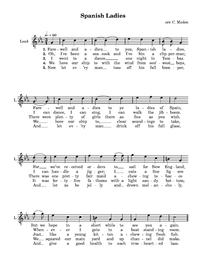
“Spanish Ladies” is a sea chantey.
Alternate names
- Farewell and Adieu
- Talcahuano Girls
- Yankee Whalermen
External links
Liner Notes
“Spanish Ladies” is track 7 on Shower Chanteys, recorded 12 March 2018 at Mill Pond Music Studio.[1]
“Spanish Ladies” is a homeward-bound capstan chantey—used for raising the anchor when returning homeward. One of a family of chanteys, originally, “Spanish Ladies” was a British naval song, lamenting separation from local wives or girlfriends from Gibraltar at the end of the Napoleonic wars. Hugill notes that few sources give it as a proper chantey (as opposed to just a recreational song).[2] The original was a navigational mnemonic for the trip through the English Channel around to the Thames and London; as the song was coöpted by other groups, including New England whalers, the lyrics changed accordingly. Smith, in 1888, seemed unaware of the New England variation.[3]
The melody changes in some variations; the British version, I’ve never heard except with a minor key; the New England version I’ve heard in both minor and major variations, though the Talcahuano Girls version, a close cousin of the Yankee version, is always minor; the Newfoundland version always seems to be in a major key.
Some of the British verses survive into this New England version I recorded. Other verses are common to the more generic whaling versions, but the refrain is based entirely in New Bedford whaling.
I was a little uncertain about this recording. I wanted to have the melody doubled an octave apart, but as it has a moderately wide range in the melody alone, that forced me to the bottom or top of my range for the main lead part. There seems to be a general consensus among the people I’ve asked—including my recording engineer—that it sounds fine down in the basement of my range where it ended up. It’s easy as a singer to hear only the errors and problems… but as I often tell people at chantey sings, there are only two ways to sing sailors’ songs: good, and authentic. I guarantee you, as I guarantee them, that this recording is at least one of those two.
References
- ↑ “Spanish Ladies,” recording by Chris Maden. MusicBrainz.
- ↑ Stan Hugill. Shanties from the Seven Seas, pp. 292–294. New U.S. Edition. Mystic, Conn.: Mystic Seaport, 1994.
- ↑ Laura Alexandrine Smith. The Music of the Waters, pp. 63–64. London: Kegan Paul, Trench & Co., 1888.
